
My research brings together transdisciplinary systems thinking approaches and methods to understand complex social-ecological systems.
CURRENT PROJECTS
Indigenous (Adivasi) Foodways for Sustainable Food Futures
Tufts Springboard grant (2024-2026)
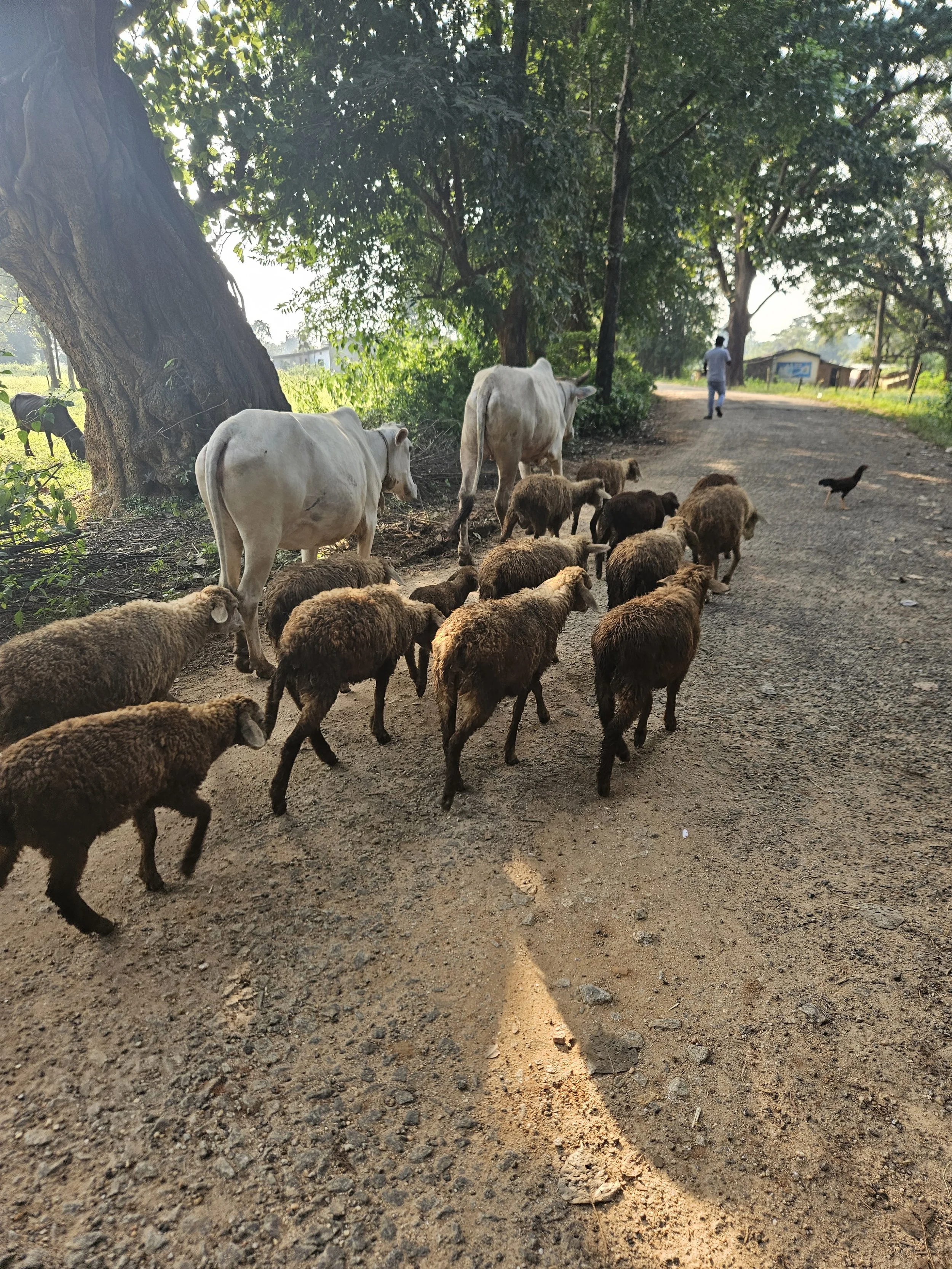
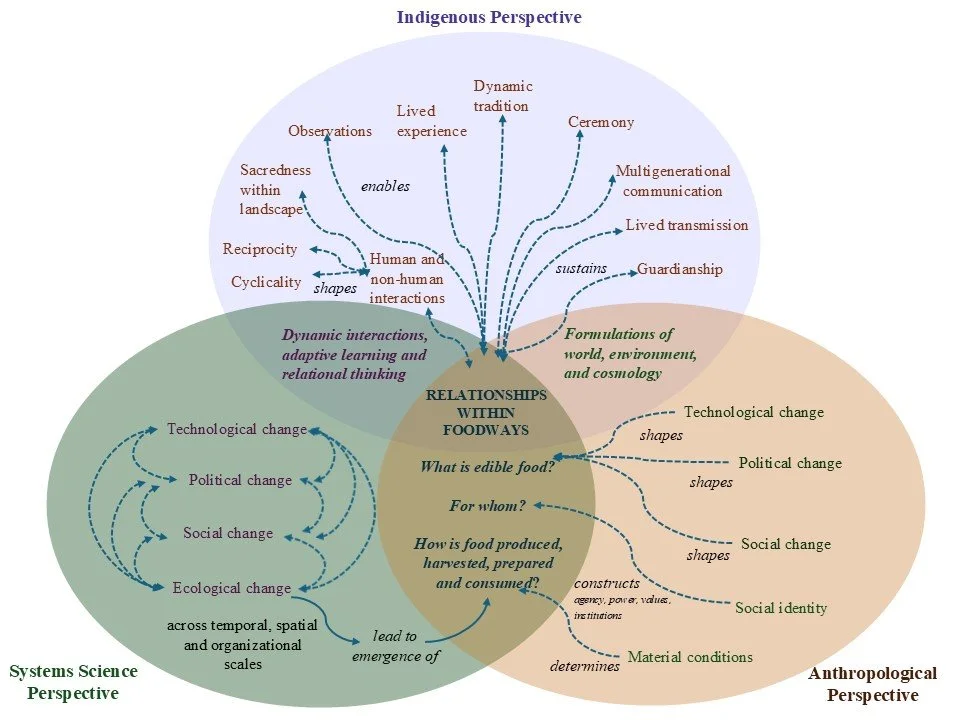
This project brings together an interdisciplinary team across systems science, anthropology, nutrition, and agroecology in partnership with indigenous communities in Eastern India to i) trace the co-evolution of Adivasi food systems with political, economic, and ecological changes over time; ii) develop an integrated framework for understanding foodways bridging indigenous research, systems science, and anthropological perspectives; and iii) foreground indigenous perspectives into food systems discourse and pathways towards sustainable food futures.
-
Sanga, U., Pinto, S., Messer, E., Vance, E., Collective, A.K. (2026) (in press). Indigenous (Adivasi) foodways: Bridging Indigenous Research, Systems Science and Anthropology for Sustainable Food Futures Diverse Indigenous Knowledge for Sustainability: Perspectives, Challenges, and Opportunities. Cambridge University Press.
-
Food as complex biocultural ecologies: Interwoven relationships among land, nutrition, and indigenous food practices in Jharkhand (expected submission to Agriculture and Human Values journal in November 2026)
Indigenous Foodways as Relational Pathways of Adaptation, Resilience, and Social-Ecological Transformation in Eastern India (expected submission to Ecology & Society in November 2026)
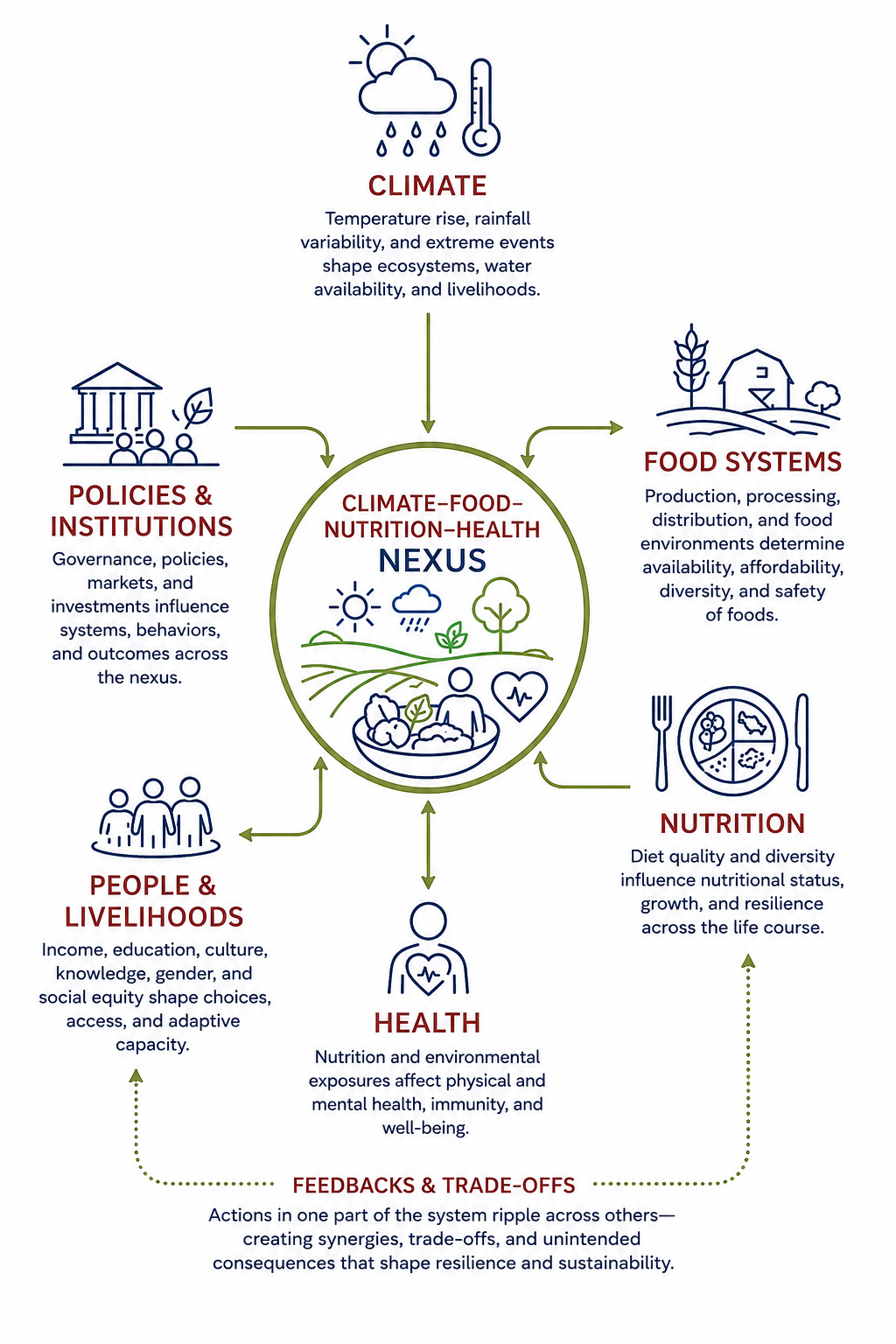
Modelling Pathways for Climate-Food-Nutrition-Health Nexus for Human and Planetary Health
ICNSM seed grant (2025-2026)
This project represents the second phase of the Adivasi Foodways research, expanding the work to include Particularly Vulnerable Tribal Groups (PVTGs) in Karnataka and connecting insights from the earlier foodways research to broader questions of climate, food, nutrition, health, and policy in India.
Building on a place-based understanding of Indigenous food practices, knowledge, and social-ecological change, this phase examines how climate and environmental change affect health through interconnected food and nutrition pathways. It also explores how agricultural, food, nutrition, and social protection policies intersect with these pathways and shape household choices, vulnerabilities, and opportunities for adaptation.
The project combines community-grounded data and knowledge with GIS-based climate analysis and system dynamics modelling to connect lived experiences with broader climatic and policy dynamics. Through this integration, we aim to identify locally grounded and policy-relevant pathways toward climate resilience, food and nutrition security, and human and planetary health.
A Growing Vision
My vision is to expand this work across Indigenous communities in South and Southeast Asia, exploring the connections among food and biodiversity, Indigenous knowledge and economies, human health and well-being, and climate resilience. Through comparative, community-grounded research, I hope to understand how diverse foods, landscapes, livelihoods, and ways of knowing can contribute to healthier, more equitable, and resilient pathways for people and the environments they inhabit.
If you are interested in contributing to this work, sharing knowledge, or exploring opportunities for collaboration, please get in touch. I welcome connections with Indigenous communities and knowledge holders, researchers, practitioners, artists, and organizations working toward similar goals.
SELECTED PAST RESEARCH
●──────────── 2020–2023
Agricultural Innovation, Food Security & Poverty Traps in West Africa
Stockholm Resilience Centre, Sweden | Funder: European Research Council (ERC)
Agent-Based Modeling · Innovation Systems · Food Security
Exploring how agricultural innovations emerge and spread through farmer networks and how interactions among innovation pathways, climate risk, soil fertility, and farmer resources shape food security, inequality, and the emergence or persistence of poverty traps in West Africa.
Publications:
Sanga, U., Radosavljevic, S., & Schlüter, M. (2025). Emergence of cross-level poverty traps in agricultural innovations systems: Environmental impacts and sustainable interventions. Agricultural Systems, 233, 104596
Sanga, U., & Schlüter, M. (2025). Stories, simulations, and narratives: Collaboratively exploring food security and agricultural innovation in sub-Saharan Africa. Agricultural Systems, 224, 104241.
Radosavljevic, S., Sanga, U., & Schlüter, M. (2024). Navigating simplicity and complexity of social-ecological systems through a dialogue between dynamical systems and agent-based models. Ecological Modelling, 495, 110788.
Sanga, U., Schlüter, M., & Berrío-Martínez, J. (2023). Modelling agricultural innovations as a social-ecological phenomenon. Socio-Environmental Systems Modelling, 5, 18562-18562.
●──────────── 2019–2020
Sustainable Groundwater Governance in Maharashtra, India
WOTR Centre for Resilience Studies, India | Funder: HSBC CSR
Mental Models · Systems Mapping · Water Governance
Examining how farmers perceive and respond to groundwater change in semi-arid Maharashtra and how knowledge, beliefs, institutions, and environmental conditions shape groundwater-use decisions and opportunities for more sustainable governance.
Publications:
Sanga, U., & Koli, U. (2023). Mental models of sustainable groundwater management among farmers in semi-arid regions of Maharashtra, India. Groundwater for Sustainable Development, 100904.
●──────────── 2016–2018
Climate Adaptation & Farmer Decision-Making in the Indo-Gangetic Plains of India
National Socio-Environmental Synthesis Center (SESYNC), USA | Funder: National Science Foundation (NSF)
Climate Adaptation · Agent-Based Modeling · Structural Equation Modeling
Investigating how smallholder farmers make adaptation decisions under climate risk by integrating household survey and remote-sensing data with structural equation and agent-based models to understand vulnerability and adaptation from the ground up.
Publications:
Sanga, U., Park, H., Wagner, C. H., Shah, S. H., & Ligmann-Zielinska, A. (2021). How do farmers adapt to agricultural risks in northern India? An agent-based exploration of alternate theories of decision-making. Journal of Environmental Management, 298, 113353.
Shah, S. H., Wagner, C. H., Sanga, U., Park, H., Demange, L. H. M. D. L., Gueiros, C., & Niles, M. T. (2019). Does household capital mediate the uptake of agricultural land, crop, and livestock adaptations? Evidence from the Indo-Gangetic Plains (India). Frontiers in Sustainable Food Systems, 3, 1.
●──────────── 2014–2019
Food Security, Climate Adaptation & Transformative Change
Michigan State University, USA | Funder: Start International, ASSAR consortium
Mali · Participatory Modeling · Systems Dynamics · Climate Adaptation
Tracing the changing trajectories of food security and social-ecological resilience in Mali following the Sahelian droughts, using participatory role-playing games and systems modeling to understand agricultural decision-making under climate uncertainty and pathways from incremental adaptation toward transformative change.
Publications:
Rivers III, L., Sanga, U., Sidibe, A., Wood, A., Paudel, R., Marquart-Pyatt, S.T., Ligmann-Zielinska, A., Olabisi, L.S., Du, E.J. and Liverpool-Tasie, S., 2018. Mental models of food security in rural Mali. Environment Systems and Decisions, 38(1), pp.33-51
Sanga, U., Sidibé, A., & Olabisi, L. S. (2021). Dynamic pathways of barriers and opportunities for food security and climate adaptation in Southern Mali. World Development, 148, 105663.
●──────────── 2013–2014
Agricultural Innovation & Climate-Resilient Maize
International Maize and Wheat Improvement Center (CIMMYT), New Delhi | Funder: CGIAR Trust Fund & bilateral funds
India & Bangladesh · Technology Adoption · Climate Resilience · Food Security
Examining the factors shaping smallholder adoption of improved maize varieties and the opportunities and constraints associated with stress-tolerant technologies to strengthen farm incomes and food security under challenging environmental conditions.
●──────────── 2012–2013
Climate-Smart Agriculture & Farmer Adaptation
International Maize and Wheat Improvement Center (CIMMYT), New Delhi | Funder: CGIAR Trust Fund & bilateral funds
India · Nepal · Bangladesh · Climate Adaptation · Agricultural Technology · Household Surveys
Contributing to the CGIAR Climate Change, Agriculture and Food Security (CCAFS) baseline study of 2,500 households across South Asia to understand farmers’ exposure and responses to climate risks, including adaptation strategies, climate-risk management, and adoption of climate-smart agricultural practices across the Indo-Gangetic Plains.
●──────────── 2011–2012
Climate Resilience & Microinsurance
Micro Insurance Academy, New Delhi | Funder: Swiss Agency for Development & Cooperation
Bihar & Maharashtra, India · Climate Resilience · Microinsurance · Risk Management
Exploring community-based pro-poor microinsurance solutions to strengthen the resilience of communities vulnerable to climate risks, with a focus on managing interconnected risks to human health, crops, and livestock exacerbated by climate change.
●──────────── 2010–2011
Climate Risk & Agricultural Insurance
Micro Insurance Academy, New Delhi
Nghe An, Vietnam · Climate Resilience · Agricultural Insurance · Risk Assessment
Assessing climate change impacts and risks facing agricultural communities in coastal Vietnam and exploring the potential for agricultural insurance to strengthen resilience through an assessment of both the demand for and supply of insurance solutions in Nghe An province.
●──────────── 2008–2010
BEHAVE (Behavioral Education for Human, Animal, Vegetation and Ecosystem Management)
Utah State University, Logan
Rangelands· Behavioral ecology · Sheep· Self-Medication
Assessing maternal effects in transmission of self-medicative behavior from mother to offspring in sheep
Publication:
Sanga, U., Provenza, F. D., & Villalba, J. J. (2011). Transmission of self-medicative behaviour from mother to offspring in sheep. Animal Behaviour, 82(2), 219-227.